
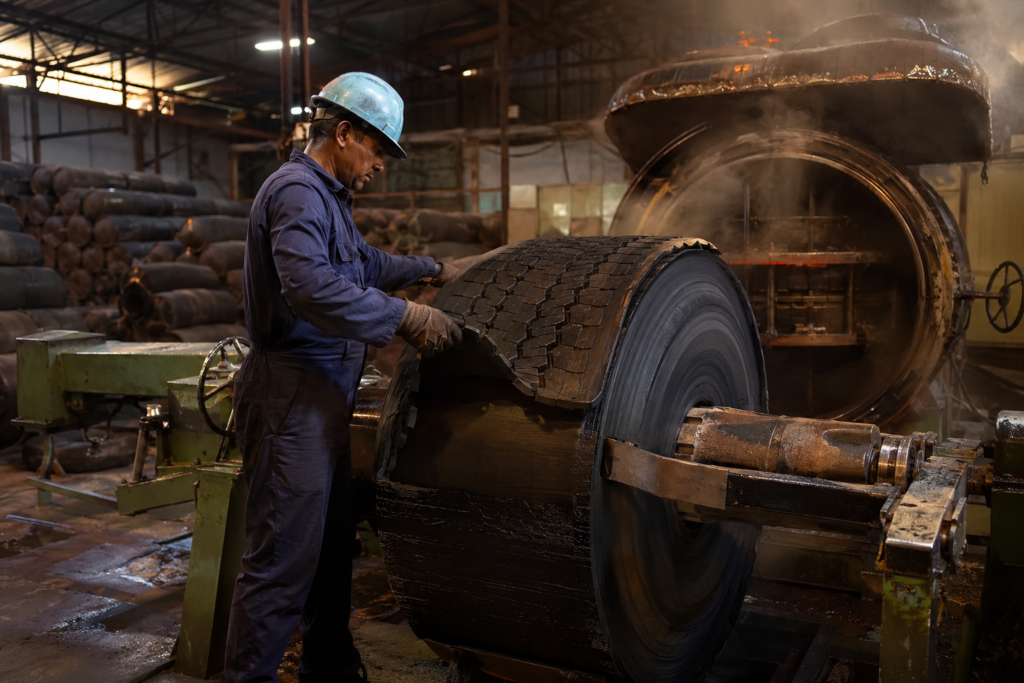
In this guide, we break down exactly what hot process retreading rubber is, how the process works, why it outperforms alternatives in certain applications, and how to choose the right compound for your fleet. Whether you run a retreading unit or manage a transport business, this article will help you make an informed, cost-effective decision.
What Is Hot Process Tyre Retreading Rubber?
Hot process tyre retreading rubber, commonly known as camelback rubber, is an uncured rubber compound applied over a prepared (buffed) tyre casing. Unlike pre-cured tread rubber used in cold process retreading, this compound has not yet been vulcanized. It is shaped onto the casing and then placed inside a heated mould, where heat and pressure trigger vulcanization — chemically bonding the new rubber to the old casing as a single, unified structure.
Because the mould imprints the tread pattern during curing, hot process retreading allows for custom tread designs tailored to specific applications, such as deep lugs for off-road traction or reinforced shoulders for heavy load-bearing axles.
Key Characteristics of Hot Process Retreading Rubber
- Uncured compound: Vulcanizes directly onto the casing during the moulding stage.
- Strong molecular bonding: Creates a near-seamless connection between old and new rubber.
- Custom tread patterns: Mould-based curing enables application-specific designs.
- High heat and abrasion resistance: Ideal for rough, uneven, or high-load surfaces.
- Wide compatibility: Suitable for bias-ply and radial casings alike.
How the Hot Process Tyre Retreading Method Works
Understanding the retreading workflow helps operators appreciate why quality rubber compound selection is so critical. Here is the typical step-by-step process:
- Casing Inspection: The tyre casing is thoroughly inspected for structural damage, punctures, or weak spots using visual checks and shearography or X-ray equipment.
- Buffing: The old tread is buffed off to create a clean, roughened surface for optimal rubber bonding.
- Repairing: Any minor damage, such as small punctures, is repaired using appropriate rubber compounds and gum.
- Cementing: A bonding cement/solution is applied to the buffed surface to enhance adhesion.
- Building/Applying Camelback Rubber: The uncured hot process retreading rubber is applied around the casing.
- Mould Curing: The tyre is placed into a heated mould where controlled heat and pressure vulcanize the rubber and imprint the tread pattern.
- Final Inspection and Quality Testing: The retreaded tyre undergoes balance checks, visual inspection, and quality assurance testing before dispatch.
Each of these stages depends on using a rubber compound engineered for consistent curing behavior, strong tensile strength, and long-term durability — which is where compound quality becomes the single biggest differentiator between a retread that lasts and one that fails prematurely.
Hot Process vs. Cold Process Retreading: Which One Do You Need?
Many fleet operators ask whether hot process or cold process (precured) retreading is better. The honest answer: it depends on your application.
Hot Process Retreading Is Best For:
- Off-road, mining, and construction vehicles
- Heavy commercial trucks operating on uneven or rugged terrain
- Applications requiring custom tread patterns
- Situations demanding maximum bonding strength between casing and tread
Cold Process (Precured) Retreading Is Best For:
- Highway and long-haul fleets running on smoother roads
- Retreaders wanting faster turnaround times
- Operations prioritizing lower energy consumption during retreading
For businesses that operate mixed fleets, it’s common to use both methods strategically — hot process for rugged-duty vehicles and cold process for highway fleets — to optimize both cost and performance.
Why Rubber Compound Quality Makes or Breaks Retreading Success
Not all hot process retreading rubber is created equal. The performance of a retreaded tyre depends heavily on the quality, consistency, and formulation of the rubber compound used. Poor-quality compounds can lead to premature tread separation, uneven wear, or heat build-up that compromises safety.
What to Look for in a Quality Hot Process Retreading Compound
- Optimal curing characteristics: Consistent vulcanization at standard mould temperatures.
- High tensile and tear strength: Ensures durability under heavy loads.
- Low heat build-up: Reduces the risk of tread separation during long-distance running.
- Good abrasion resistance: Extends tread life on rough surfaces.
- Consistent batch quality: Ensures predictable results across production runs.
This is precisely why sourcing rubber compounds from an experienced, quality-focused manufacturer matters. At Pal Rubber Industries, every batch of hot process tyre retreading rubber is formulated and tested to meet strict performance benchmarks, ensuring retreaders and fleet operators get consistent, reliable results batch after batch.
Benefits of Choosing Hot Process Tyre Retreading Rubber
1. Significant Cost Savings
Retreading a tyre typically costs a fraction of buying a new one, allowing fleet operators to extend the useful life of expensive casings without the full capital expense of replacement tyres.
2. Environmental Sustainability
Retreading reduces rubber waste and lowers the demand for raw materials and energy used in manufacturing brand-new tyres, supporting circular-economy practices in the transport and logistics sector.
3. Customizable Performance
Because hot process retreading involves mould curing, tread patterns can be tailored precisely to the operating conditions — deep lugs for mud and gravel, or ribbed patterns for stability on mixed terrain.
4. Reliable Bonding Strength
The vulcanization process fuses the new rubber directly to the casing at a molecular level, offering strong adhesion that performs well under continuous heavy loads.
Common Applications of Hot Process Retreading Rubber
- Heavy commercial trucks and multi-axle trailers
- Mining and quarry equipment tyres
- Construction and earthmoving machinery
- Agricultural and industrial vehicles
- Bus fleets operating on regional or rural routes
Fleet managers looking to source dependable compounds for these applications can explore Pal Rubber Industries’ full range of tyre retreading rubber products designed for varied vehicle categories and operating environments.
How to Choose the Right Hot Process Retreading Rubber Supplier
Selecting the right supplier is just as important as selecting the right compound. Here’s a quick checklist:
- Manufacturing experience: Look for suppliers with a proven track record in rubber compounding for tyre applications.
- Quality certifications and testing protocols: Ensure the manufacturer follows standardized quality control processes.
- Consistent batch-to-batch quality: Ask for samples or test reports before large orders.
- Technical support: A good supplier should help you select the right compound grade for your specific application.
- Transparent communication and after-sales support: Reliable suppliers stay accessible for queries, complaints, or bulk order support.
Pal Rubber Industries has built its reputation on these very principles, supplying hot process tyre retreading rubber to retreaders and transport businesses who need dependable, tested compounds at competitive pricing. To understand our manufacturing standards in detail, visit our quality assurance page.
Industry Standards and Best Practices
Reputable retreading operations align with globally recognized standards to ensure safety and performance. Organizations such as the Tyre Retreading Business Association (TRIB) and international bodies like the International Organization for Standardization (ISO) provide guidelines on casing inspection, compound performance, and process safety. Additionally, resources from the American Society for Testing and Materials (ASTM) outline rubber testing methodologies relevant to compound tensile strength, hardness, and abrasion resistance — benchmarks that responsible manufacturers use to validate product quality.
Following such standards isn’t just about compliance — it directly impacts road safety, fleet uptime, and the long-term reputation of a retreading business.
Maintenance Tips to Maximize Retread Life
- Maintain correct tyre inflation pressure at all times to prevent uneven wear.
- Rotate tyres regularly based on manufacturer recommendations.
- Conduct routine visual inspections for cuts, bulges, or embedded objects.
- Avoid overloading vehicles beyond the tyre’s rated capacity.
- Store retreaded tyres in cool, dry conditions away from direct sunlight.
Why Choose Pal Rubber Industries for Hot Process Retreading Rubber?
With years of expertise in rubber compounding, Pal Rubber Industries has become a trusted name for retreaders and fleet operators across India. Our hot process tyre retreading rubber compounds are engineered for:
- Consistent curing performance across production batches
- High tensile strength and abrasion resistance
- Reliable bonding for long-lasting retreads
- Competitive pricing without compromising on quality
We understand that every fleet has unique operating conditions, which is why our technical team works closely with customers to recommend the right compound grade for their specific use case. Learn more about our manufacturing capabilities on our manufacturing process page.
Get in Touch With Pal Rubber Industries
Looking for high-quality hot process tyre retreading rubber for your fleet or retreading business? Our team is ready to help you choose the right compound for your requirements.
📞 Call us: +91 98710 01723
📧 Email us: contact@palrubberindustries.com
Conclusion
Hot process tyre retreading rubber remains one of the most durable and cost-effective solutions for extending the life of heavy-duty tyres, especially in demanding, off-road, and rugged terrain applications. By understanding how the process works, what to look for in a quality compound, and how to choose the right supplier, fleet operators and retreaders can significantly reduce costs while maintaining safety and performance standards.
If you’re ready to upgrade your retreading operations with dependable, quality-tested rubber compounds, Pal Rubber Industries is here to help — from product selection to technical guidance and bulk supply.
📞 Contact Pal Rubber Industries today at +91 98710 01723 or email contact@palrubberindustries.com to discuss your tyre retreading rubber requirements.
Frequently Asked Questions (FAQs)
1. What is hot process tyre retreading rubber?
Hot process tyre retreading rubber, also called camelback rubber, is an uncured compound applied to a prepared tyre casing and vulcanized under heat and pressure in a mould, forming a strong bond between the new tread and the old casing.
2. How is hot process retreading different from cold process (precured) retreading?
Hot process retreading uses uncured rubber vulcanized directly on the casing, allowing custom tread patterns and stronger bonding — ideal for rough terrain. Cold process retreading uses pre-cured tread rubber bonded at lower temperatures, offering faster turnaround for highway use.
3. How long does hot process retreaded rubber last on a tyre?
With proper casing selection, correct compound choice, and good maintenance, hot process retreads can deliver mileage comparable to 60-90% of a new tyre’s life, depending on application and load conditions.
4. Is hot process retreading suitable for all vehicle types?
It’s widely used for trucks, buses, earthmovers, and industrial or off-road vehicles that experience heavy casing stress. It’s less common for passenger cars, which typically use cold process retreading or new tyre replacement.
5. Where can I buy quality hot process tyre retreading rubber in India?
Pal Rubber Industries manufactures and supplies quality-tested hot process tyre retreading rubber across India. Contact us at +91 98710 01723 or contact@palrubberindustries.com for specifications, samples, and pricing.