
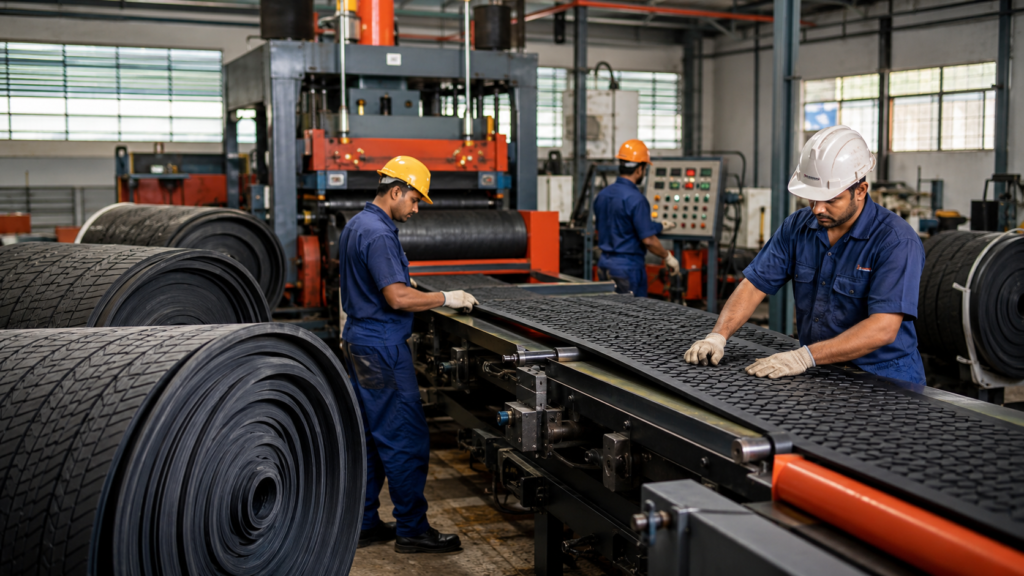
India has quietly become one of the world’s most dependable hubs for industrial rubber production. Whether you’re sourcing gaskets for a machine assembly line or custom-molded seals for pharmaceutical equipment, understanding how to evaluate a rubber manufacturer in India can save you time, money, and unnecessary production delays.
This guide walks you through everything a buyer needs to know before signing a purchase order — from the types of rubber products available in the Indian market, to the quality benchmarks that separate a dependable supplier from a risky one.
Why India Has Become a Preferred Sourcing Destination for Rubber Products
Over the past two decades, India’s rubber processing industry has expanded significantly, supported by domestic natural rubber cultivation, a growing base of synthetic rubber compounding expertise, and a large pool of skilled labor. According to the Rubber Board of India, the country remains among the top producers and consumers of natural rubber globally, which gives domestic manufacturers a raw-material advantage that many overseas buyers find cost-effective.
Buyers increasingly turn to Indian manufacturers because of:
- Cost efficiency without compromising on material grade
- Flexible production runs, from small prototype batches to large industrial orders
- Custom compounding for specific hardness, temperature resistance, or chemical resistance needs
- Faster turnaround compared to several other manufacturing regions
- Compliance readiness with international quality frameworks such as ISO standards
Types of Rubber Products Manufactured in India
Not every manufacturer specializes in the same category of rubber goods. Before shortlisting a supplier, it helps to understand the broad categories available in the Indian market.
1. Molded Rubber Components
These include custom rubber parts shaped using compression, transfer, or injection molding techniques — commonly used in automotive assemblies, electrical enclosures, and machinery. Explore our range of molded rubber products to see examples of precision-engineered components.
2. Rubber Sheets and Rolls
Used widely in flooring, insulation, and gasket cutting applications, rubber sheets are produced in various thicknesses and hardness levels, including natural rubber, EPDM, neoprene, and silicone variants.
3. Gaskets, Seals, and O-Rings
These precision components are critical for preventing leaks and maintaining pressure integrity in pipelines, pumps, and industrial equipment.
4. Rubber-to-Metal Bonded Parts
Used in vibration dampeners, mounts, and couplings, these products combine rubber’s flexibility with metal’s structural strength.
5. Specialty Rubber Compounds
This includes silicone rubber for food-grade or medical applications, EPDM for weather-resistant outdoor use, and nitrile rubber for oil and fuel resistance.
How to Evaluate a Rubber Manufacturer in India: A Step-by-Step Checklist
Choosing the right supplier isn’t just about the lowest quote. Here’s a practical evaluation process buyers should follow:
- Verify manufacturing capability — Confirm whether the company owns in-house molding, mixing, and finishing equipment, or if it outsources production.
- Check quality certifications — Look for ISO 9001 certification and material test reports for critical applications.
- Review material sourcing transparency — Ask whether raw rubber and additives are sourced from traceable, quality-tested suppliers.
- Assess customization ability — A capable manufacturer should be able to adjust hardness (Shore A), color, and chemical resistance based on your application.
- Request samples before bulk orders — Always test a sample batch for dimensional accuracy and material performance.
- Evaluate communication and support — Responsive technical support often indicates a manufacturer that values long-term partnerships over one-time transactions.
- Confirm delivery and logistics capability — Especially important for buyers requiring recurring or just-in-time deliveries.
Industries That Depend on Indian Rubber Manufacturers
Rubber components touch nearly every sector of modern industry. Some of the largest buyer segments include:
- Automotive — engine mounts, weather seals, bushings, and hoses
- Construction — expansion joints, waterproofing membranes, and flooring
- Pharmaceuticals — stoppers, seals, and tubing requiring food/medical-grade compliance
- Electrical & Electronics — insulating components and protective grommets
- Oil & Gas — high-pressure seals and chemically resistant gaskets
- Agriculture — irrigation seals, tractor components, and vibration dampeners
For buyers in these sectors, working with a manufacturer that understands sector-specific compliance requirements can significantly reduce the risk of component failure. You can learn more about industry-specific solutions on our industries we serve page.
Common Mistakes Buyers Make When Sourcing Rubber Products
Choosing Price Over Performance
The cheapest quote often reflects a compromise in material grade, curing time, or dimensional tolerance — all of which can cause premature product failure in the field.
Ignoring Material Data Sheets
Every rubber compound behaves differently under heat, pressure, and chemical exposure. Skipping the technical data sheet review is one of the most common — and costly — mistakes buyers make.
Not Testing Samples Under Real Operating Conditions
Lab-perfect samples don’t always perform the same way on the factory floor. Testing under actual working conditions before finalizing bulk orders is essential.
For a broader understanding of material science principles behind rubber compounding, resources like the ASTM International standards library and the International Organization for Standardization (ISO) offer authoritative technical references that serious buyers and engineers often consult.
Why Pal Rubber Industries Is a Trusted Rubber Manufacturer in India
At Pal Rubber Industries, we combine decades of hands-on manufacturing experience with a strong focus on quality-driven production. Our team works closely with engineers and procurement managers to develop rubber components that meet exact specifications — not just approximate ones.
Here’s what sets us apart:
- In-house compounding and molding capabilities for consistent quality control
- Custom formulation support for EPDM, silicone, nitrile, and natural rubber products
- Flexible order volumes, from prototype development to full-scale production
- Dedicated technical support for buyers across automotive, industrial, and infrastructure sectors
To explore our full product catalog, visit our products page, or learn more about our manufacturing standards on our about us page.
Ready to Source Reliable Rubber Products?
Whether you need standard rubber components or a fully custom-molded solution, Pal Rubber Industries is ready to support your production requirements with quality-tested materials and reliable delivery timelines.
📞 Call us: +91 98710 01723
📧 Email us: contact@palrubberindustries.com
Frequently Asked Questions
1. How do I choose a reliable rubber manufacturer in India?
Look for manufacturers with proven industry experience, proper quality certifications, in-house testing facilities, transparent material sourcing, and the ability to provide custom rubber solutions along with responsive customer support.
2. What types of rubber products are commonly manufactured in India?
Indian rubber manufacturers commonly produce molded rubber components, rubber sheets, gaskets, seals, O-rings, rubber rollers, EPDM and silicone rubber parts, and custom rubber-to-metal bonded products for various industries.
3. What is the minimum order quantity for custom rubber manufacturing?
Minimum order quantities vary by manufacturer and product complexity. Many manufacturers, including Pal Rubber Industries, offer flexible order quantities for both prototype development and bulk industrial requirements.
4. How long does it take to manufacture custom rubber components?
Lead times depend on product complexity, tooling requirements, and order volume. Simple standard products may ship within a few days, while custom-molded components with new tooling can take a few weeks.
5. Which industries rely on rubber manufacturers in India?
Automotive, construction, pharmaceuticals, electrical, oil and gas, agriculture, and general engineering industries all rely heavily on Indian rubber manufacturers for sealing, insulation, vibration control, and custom molded components.
Conclusion
Sourcing rubber components isn’t just a procurement task — it’s a decision that directly affects product durability, safety, and long-term operating costs. As this guide has outlined, the right rubber manufacturer in India should offer more than competitive pricing; they should bring technical expertise, transparent quality practices, and the flexibility to support both prototype and bulk production needs.
Pal Rubber Industries has built its reputation on exactly these principles — combining manufacturing precision with responsive customer support to help buyers get the right rubber solution, the first time. If you’re evaluating suppliers for your next project, we’d welcome the opportunity to discuss your requirements.
Get a Custom Rubber Manufacturing Quote Today
Contact Pal Rubber Industries for product inquiries, custom specifications, or bulk order requirements.
Explore more: Our Products | About Us | Contact Us