
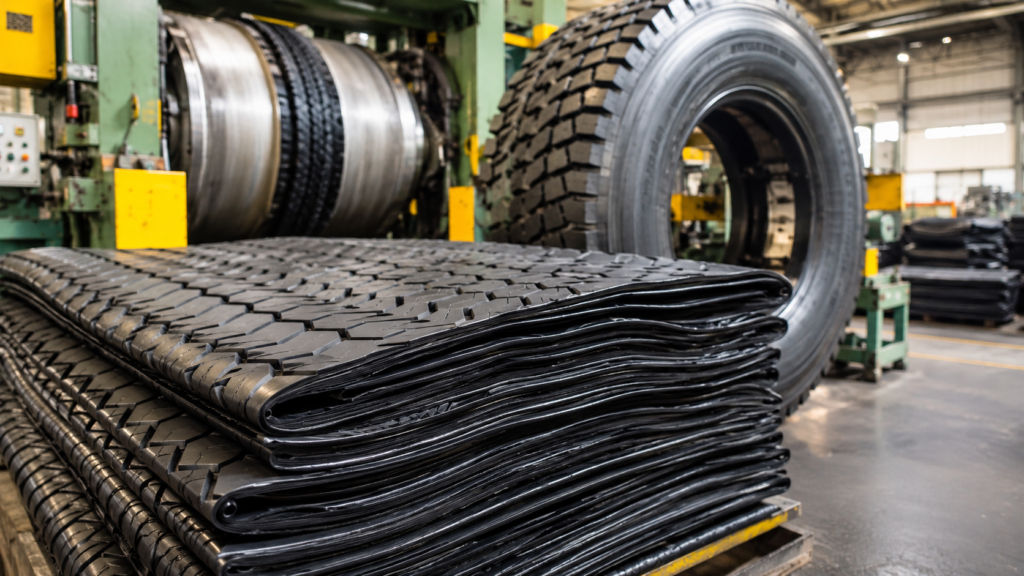
If you run a fleet of trucks, buses, or heavy commercial vehicles, tyre costs are probably one of your biggest recurring headaches. Replacing worn-out tyres again and again eats into margins fast. This is exactly where precured tread rubber for truck tyres comes in — a proven, economical, and eco-friendly way to give your tyre casings a second (and sometimes third) life.
In this guide, we’ll break down what precured tread rubber actually is, how it’s manufactured, why it matters for commercial vehicle owners, and how to choose the right supplier for consistent, road-ready performance. Whether you manage a small transport business or a large logistics fleet, understanding this material can help you cut costs without compromising on safety.
What Is Precured Tread Rubber?
Precured tread rubber is a pre-vulcanized rubber strip, moulded with a tread pattern, that is bonded onto a worn tyre casing during the cold retreading process. Unlike hot retreading — where raw rubber is cured directly onto the tyre using heat and pressure — precured tread rubber arrives already cured and ready to bond. This makes the tyre retreading process faster, more consistent, and less energy-intensive.
The process is widely used across the commercial vehicle industry because it restores the tread depth of a truck tyre without needing to replace the entire tyre carcass, which is often still structurally sound even after the original tread has worn down.
Why It Matters for Truck Tyres Specifically
Truck tyres are built with heavy-duty steel-belted casings designed to endure high loads and long distances. These casings are expensive to manufacture, which is why truck tyre retreading with precured tread rubber makes strong economic sense — you’re reusing a durable, high-value component instead of discarding it.
Key Benefits of Using Precured Tread Rubber
- Cost savings: Commercial vehicle tyre retreading with precured tread rubber typically costs 30–50% less than buying a new truck tyre.
- Environmental impact: Reusing tyre casings reduces rubber waste and lowers the demand for raw materials and crude oil used in new tyre production.
- Consistent tread quality: Since the rubber is pre-cured in a controlled factory environment, tread thickness and compound quality remain uniform across every strip.
- Faster turnaround: Cold retreading with precured rubber takes less time than hot retreading, meaning less vehicle downtime for fleet operators.
- Better fuel efficiency: A well-retreaded tyre with the correct tread pattern maintains good rolling resistance, supporting fuel economy.
- Wide tread pattern options: Manufacturers offer multiple patterns suited to highway, regional, or off-road truck applications.
How Precured Tread Rubber Is Manufactured
Manufacturing high-quality precured tread rubber is a precise, multi-stage process. Here’s a simplified breakdown of how reputable precured tread rubber manufacturers, including Pal Rubber Industries’ product range, approach production:
- Compound formulation: Natural and synthetic rubber is blended with carbon black, silica, curing agents, and other additives to achieve the right hardness, abrasion resistance, and flexibility.
- Mixing: The compound is processed in internal mixers to ensure uniform dispersion of all ingredients.
- Extrusion and treading: The mixed rubber is extruded into tread-shaped strips using calibrated dies that create the desired tread pattern.
- Curing (vulcanization): The tread strips are cured under controlled heat and pressure, giving the rubber its final strength, elasticity, and durability before it ever reaches a retreading unit.
- Quality inspection: Each batch is tested for gauge thickness, hardness, tensile strength, and bonding compatibility before packaging and dispatch.
The Truck Tyre Retreading Process, Step by Step
Once you have quality precured tread rubber on hand, the tyre retreading process typically follows these steps at a retreading unit:
- Casing inspection: The worn tyre casing is thoroughly inspected for structural damage, punctures, or sidewall weaknesses.
- Buffing: The old tread is buffed away to create a clean, rough surface for proper bonding.
- Repairing: Any minor damage such as nail holes or small cuts is repaired using appropriate repair compounds.
- Cushion gum application: A thin layer of bonding gum is applied to the buffed surface to help the precured tread rubber adhere securely.
- Tread application: The precured tread rubber strip is applied over the casing and rolled to remove trapped air.
- Envelope and curing: The assembly is placed in a curing chamber under controlled temperature and pressure so the tread bonds permanently to the casing.
- Final inspection: The retreaded tyre is checked for balance, bonding quality, and overall safety before it’s cleared for road use.
Choosing the Right Precured Tread Rubber for Your Fleet
Factors to Consider
- Vehicle application: Long-haul highway trucks need different tread patterns than regional delivery vehicles or off-road carriers.
- Load capacity: Heavier loads require thicker gauge tread rubber with higher load-bearing compound strength.
- Climate and terrain: Hot climates demand heat-resistant compounds, while wet regions benefit from tread patterns designed for water dispersion.
- Manufacturer reliability: Consistency batch-to-batch matters enormously — inconsistent curing can lead to premature tread separation.
This is where working with an established, quality-focused manufacturer makes a real difference. At Pal Rubber Industries, our cold retreading rubber is formulated and tested specifically for the demands of Indian road and load conditions, helping fleet owners get dependable mileage out of every retread.
Precured vs. Hot Retreading: A Quick Comparison
| Aspect | Precured (Cold) Retreading | Hot Retreading |
|---|---|---|
| Process speed | Faster, since rubber is pre-cured | Slower due to on-tyre curing |
| Consistency | Highly uniform, factory-controlled | Depends on operator skill and mould condition |
| Energy use | Lower | Higher |
| Ideal for | High-volume fleet retreading | Custom or low-volume jobs |
Why Fleet Owners Trust Pal Rubber Industries
With years of experience in rubber compounding and manufacturing, Pal Rubber Industries has built a reputation for delivering precured tread rubber that retreading units and fleet operators can rely on. Our commitment to strict quality control, consistent curing standards, and a wide range of tread patterns has made us a trusted name across the commercial tyre retreading industry.
We understand that every fleet has different needs, which is why our team works closely with retreaders and transport companies to recommend the right tread rubber specification for their vehicles, routes, and load profiles. You can explore our full product lineup on our products page or learn more about our manufacturing standards on our about us page.
Industry Standards We Align With
Quality rubber manufacturing for tyre applications is guided by internationally recognized testing and material standards. For reference, you can review general material testing standards from ASTM International, quality management frameworks from ISO, and sustainability guidance on tyre lifecycle management from the U.S. Environmental Protection Agency.
Common Mistakes to Avoid When Retreading Truck Tyres
- Using a casing that has already exceeded its safe retreading limit or shows sidewall damage.
- Choosing tread rubber that doesn’t match the load rating of the vehicle.
- Skipping proper buffing, which weakens the bond between casing and new tread.
- Ignoring curing time and temperature guidelines, leading to under-cured or over-cured tread.
- Sourcing tread rubber from inconsistent or unverified suppliers.
Frequently Asked Questions (FAQs)
1. What is precured tread rubber used for in truck tyres?
Precured tread rubber is used to restore the tread on worn truck tyre casings through cold retreading, giving the tyre extended road life without needing full replacement.
2. How long does precured tread rubber last on truck tyres?
With proper application and maintenance, a precured tread can typically deliver an additional 60,000 to 90,000 kilometres of service, depending on load and road conditions.
3. Is precured tread rubber better than hot retreading?
Precured (cold) retreading generally offers more consistent tread quality and faster turnaround compared to hot retreading, making it a preferred method for commercial fleets handling high tyre volumes.
4. Which truck tyre sizes can use precured tread rubber?
Precured tread rubber is available in various widths and gauges suitable for light commercial vehicles as well as heavy-duty multi-axle trucks and buses.
5. How do I choose a reliable precured tread rubber manufacturer?
Look for a manufacturer with proven experience, consistent batch quality, proper curing standards, and a track record of serving retreading units and fleet operators — such as Pal Rubber Industries.
Conclusion
Precured tread rubber for truck tyres offers a smart middle path between cost savings and performance reliability. For fleet owners and retreading units alike, choosing quality tread rubber and following the correct retreading process can significantly extend tyre life, reduce operating costs, and support more sustainable road transport practices.
If you’re looking for consistent, road-tested precured tread rubber backed by years of manufacturing expertise, Pal Rubber Industries is ready to help you find the right fit for your fleet.
Get in Touch with Pal Rubber Industries
Ready to upgrade your fleet’s retreading quality? Contact our team today to discuss your precured tread rubber requirements, request samples, or get a custom quote.
📞 Phone: +91 98710 01723
✉️ Email: contact@palrubberindustries.com
Visit our Contact Us page to reach out, or explore our full product catalog to find the right precured tread rubber for your business.