
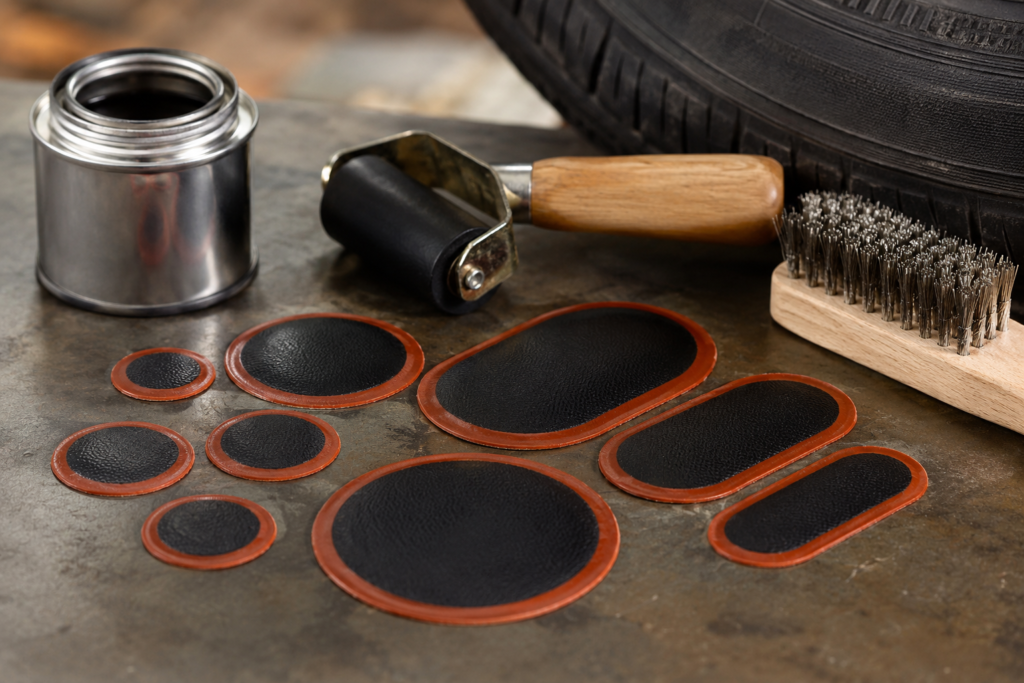
Cold process tyre patches are rubber repair patches that seal punctures in tyres and tubes without heat, using a vulcanizing (cold cement) solution to chemically bond the patch to the rubber surface. They’re widely used because they need no curing press, work well on two-wheelers, cars, and light commercial tyres, and — when applied correctly — can last for the remaining life of the tyre.
If you run a tyre repair shop, a mobile puncture-repair service, or manage a small vehicle fleet, you’ve probably reached for a cold process patch more times than you can count. It’s fast, it doesn’t need electricity, and it gets a vehicle back on the road within minutes. But not every patch — or every application job — is created equal. This guide breaks down exactly what cold process tyre patches are, the different types available, how to apply them correctly, and how to choose materials that won’t let you down on the road.
What’s in this guide
What Is a Cold Process Tyre Patch?
A cold process tyre patch is a pre-formed rubber patch, usually with a fabric or ply backing, that repairs a puncture at ambient temperature. Instead of curing the rubber with heat and pressure — as hot vulcanizing does — this method uses a cold vulcanizing solution (a chemical rubber cement) to activate the patch’s bonding layer and fuse it to the tyre or tube surface.
This makes it a go-to solution for roadside vans, small workshops, and rural repair centres where a hot curing press isn’t practical. For a closer look at the compounds and construction used in these repairs, see our tyre and tube repair product range.
Types of Cold Process Tyre Patches
Choosing the right patch shape and construction for the injury is one of the biggest factors in repair longevity.
| Patch Type | Best For | Notes |
|---|---|---|
| Round patches | Small, circular puncture holes | Most common patch type; available in multiple diameters |
| Oval patches | Elongated cuts or slits | Better coverage along irregular injury shapes |
| Radial ply (fabric-reinforced) | Steel-belted radial tyres | Restores structural strength to the repaired zone |
| Truck & bus patches | Heavy commercial tyres | Thicker rubber gauge for higher load and heat tolerance |
Cold Process vs. Hot Vulcanizing: Which Should You Use?
- Equipment needed: Cold process needs no electricity or curing press; hot vulcanizing requires a heated mould.
- Speed: Cold patching is generally faster for small to medium punctures.
- Best use case: Cold process suits two-wheelers, cars, and light commercial vehicles; hot vulcanizing is often preferred for larger structural repairs on heavy truck or OTR tyres.
- Investment: Cold process requires lower upfront equipment cost, making it ideal for smaller workshops.
Step-by-Step: How to Apply a Cold Process Tyre Patch
- Find the puncture — submerge the tube in water, or apply soap solution on the tyre, and watch for air bubbles.
- Clean the surface — remove dirt, moisture, and old rubber using a wire brush.
- Buff lightly — roughen the area around the injury without over-thinning the rubber.
- Apply vulcanizing solution — spread a thin, even layer slightly wider than the patch.
- Let it turn tacky — usually 3–5 minutes, depending on temperature and humidity.
- Press the patch on — peel the foil backing and press firmly from the centre outward.
- Roll out trapped air — use a stitching roller for full, even contact.
- Hold pressure and cure — before remounting the tyre or tube.
Common Mistakes That Ruin a Cold Patch Repair
- Pressing the patch on before the cement is properly tacky
- Using an undersized patch for the injury
- Skipping full moisture/contamination removal from the repair zone
- Not rolling out air pockets, leaving weak spots
- Using old or expired vulcanizing fluid that’s lost its bonding strength
Why Patch Quality Actually Matters
Compound formulation and fabric-ply quality determine how a patch performs under real driving stress — heat cycling, load, and vibration. At Pal Rubber Industries, patches are manufactured with carefully controlled rubber compounds for consistent adhesion and long-term elasticity. You can explore our full product catalogue or learn more about our manufacturing standards on the About Us page.
Buying Guide: What Workshops & Distributors Should Check
- Match your repair volume — stock a mix of round, oval, and radial-ply patches for common injury types.
- Ask for a compound data sheet — confirms the rubber specification used.
- Check shelf life — vulcanizing fluid degrades over time; buy what you’ll use within its rated window.
- Request samples first — test adhesion under your local climate before committing to a bulk order.
Get Reliable Cold Process Tyre Patches for Your Workshop
Pal Rubber Industries manufactures a full range of cold process tyre and tube patches built for consistent, long-lasting repairs — from two-wheelers to heavy commercial tyres.
📞 +91 98710 01723 | ✉️ contact@palrubberindustries.com
Frequently Asked Questions
What exactly is a cold process tyre patch?
It’s a rubber repair patch bonded to a tyre or tube at room temperature using a chemical vulcanizing solution, instead of heat and a curing press.
Does cold patching work as well as hot vulcanizing?
Yes, for most passenger, two-wheeler, and light commercial tyres, cold patching gives a strong, air-tight seal when surface prep and materials are good quality.
How long will a cold process patch hold up?
A correctly applied patch typically lasts for the remaining life of the tyre, provided it matches the injury size and was applied with proper technique.
Are cold patches suitable for radial tyres?
Yes, fabric-reinforced radial ply patches are built specifically to repair steel-belted radial tyres without weakening the structure.
Who supplies reliable cold process tyre patches in India?
Pal Rubber Industries manufactures and supplies cold process tyre patches across India. Contact +91 98710 01723 or contact@palrubberindustries.com for product details and bulk orders.