Why Delhi NCR Is a Major Hub for Rubber Manufacturing
Delhi NCR — spanning Delhi, Faridabad, Ghaziabad, Noida, and Gurugram — has grown into one of India’s densest industrial clusters. Faridabad alone hosts thousands of small and medium manufacturing units, many of them serving the automotive, engineering, and construction sectors. This concentration means:
- Faster raw material sourcing from local rubber and polymer suppliers
- Shorter logistics routes to Delhi, Haryana, UP, and Punjab-based buyers
- A skilled labour pool with decades of moulding and compounding experience
- Competitive pricing due to supplier density and healthy competition
But density also means variability. Not every unit invests equally in quality control, testing, or compliance — which is exactly why due diligence matters.
What Makes a Rubber Manufacturer “Good”? 7 Things to Check
1. Manufacturing Capability, Not Just Trading
Many companies listed online are traders who outsource production and mark up the price. Ask directly: “Do you manufacture in-house, or do you subcontract?” A genuine manufacturer will readily share factory details, machine lists, and production capacity.
2. Material Quality & Certification
Rubber compounds vary wildly in performance. Ask for:
- Material test certificates (hardness, tensile strength, elongation)
- Compliance with relevant standards (ISO, ASTM, IS specifications)
- Batch traceability records
For a general primer on how rubber grades are classified, the ASTM standards library is a useful reference point when comparing supplier claims.
3. Range of Rubber Products Offered
A manufacturer with a broad, well-documented product range usually signals deeper process expertise. Check whether they produce:
- Moulded rubber components (gaskets, seals, bushes, grommets)
- Extruded rubber profiles and sheets
- Silicone and EPDM rubber parts
- Custom rubber-to-metal bonded parts
You can browse an example of a well-documented catalogue on the Pal Rubber Industries products page, which lists specifications alongside each category.
4. Custom Manufacturing & Tooling Support
If your application needs a non-standard shape or hardness, ask whether the manufacturer can develop custom moulds or dies in-house, and how long tooling typically takes. Manufacturers without in-house tool rooms often quote longer lead times because they outsource this step too.
5. Quality Testing Infrastructure
A serious manufacturer should be able to describe their in-house testing — hardness (durometer) testing, tensile testing, compression set testing, and visual/dimensional inspection — before parts are dispatched. If a supplier can’t explain their QC process in one sentence, that’s a red flag.
6. Track Record & Client Base
Ask for industries they’ve served — automotive OEMs, construction equipment makers, electrical panel manufacturers, or railways. A manufacturer with cross-industry experience is generally better equipped to handle unusual specifications.
7. Transparent Pricing, MOQ & Lead Times
Get written quotes with clear minimum order quantities (MOQ) and delivery timelines. Vague verbal promises (“we’ll manage it somehow”) are a common source of delayed production runs.
Common Mistakes Buyers Make While Choosing a Rubber Supplier
- Choosing on price alone — the cheapest quote often means lower-grade compound or thinner walls that fail early.
- Skipping sample testing — always request a sample batch before a bulk order.
- Ignoring after-sales support — check whether the manufacturer assists with replacements or design revisions post-delivery.
- Not verifying business legitimacy — cross-check GST registration and physical factory address.
How to Shortlist Rubber Manufacturers in Delhi NCR: A Step-by-Step Process
- Define your specification sheet — dimensions, hardness (Shore A/D), material type, quantity, and application environment (temperature, chemical exposure, load).
- Shortlist 4–5 manufacturers based on product range and industry experience.
- Request samples and test certificates for each shortlisted vendor.
- Compare lead times and MOQs, not just unit price.
- Visit the factory if possible, or request a virtual walkthrough.
- Place a trial order before committing to a long-term contract.
Why Businesses Across Delhi NCR Choose Pal Rubber Industries
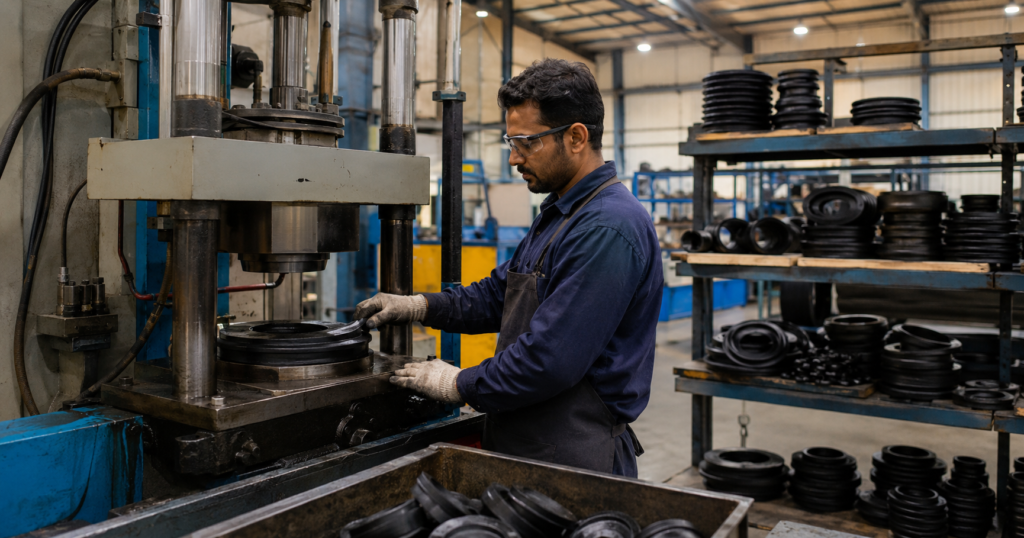
At Pal Rubber Industries, we’ve built our reputation on a simple principle: every batch should perform exactly as specified, every time. Our manufacturing setup is designed to serve automotive, construction, electrical, and general industrial clients who can’t afford inconsistent quality.
Here’s what sets our process apart:
- In-house compounding, moulding, and tooling — no unnecessary subcontracting
- Custom rubber component design support for non-standard applications
- Batch-wise quality testing before dispatch
- Flexible order quantities for both trial runs and bulk production
- Responsive support for repeat orders and urgent requirements
Whether you need standard rubber gaskets or a fully custom moulded component, our team can walk you through material selection and lead times before you commit to an order.
Industry Standards Worth Knowing
Before finalising any supplier, it helps to understand the broader quality frameworks that reputable rubber manufacturers align with. The ISO Technical Committee for Rubber and Rubber Products maintains global benchmarks for material testing and classification, while India’s own Bureau of Indian Standards (BIS) sets domestic compliance requirements that many industrial buyers now ask suppliers to reference during procurement.
Frequently Asked Questions
1. How do I verify if a rubber manufacturer in Delhi NCR is genuine?
Check their GST registration, ask for a factory address you can visit or verify online, request material test certificates, and look for a documented product catalogue rather than a single generic landing page.
2. What is the typical MOQ for custom rubber parts?
MOQs vary by manufacturer and part complexity, but many Delhi NCR manufacturers offer flexible trial-batch quantities for new clients before scaling to bulk orders. It’s best to confirm this directly with the supplier for your specific specification.
3. Can I get custom-moulded rubber components made to my exact drawing?
Yes. Most established manufacturers, including Pal Rubber Industries, offer custom tooling and moulding based on your drawings or sample parts, with material and hardness matched to your application.
4. What industries commonly source rubber components from Delhi NCR manufacturers?
Automotive, construction equipment, electrical and electronics, railways, and general industrial machinery are among the most common sectors sourcing rubber parts from this region, due to its proximity to major industrial belts.
5. How do I get a quote from Pal Rubber Industries?
You can call us at +91 98710 01723, email contact@palrubberindustries.com, or fill out the enquiry form on our Contact Us page. Share your specification sheet or sample drawing for the fastest turnaround on your quote.
Conclusion
Finding a good rubber manufacturer in Delhi NCR isn’t about picking the first search result — it’s about verifying manufacturing capability, material quality, testing rigor, and after-sales reliability before you commit. Use the checklist and shortlisting process above, ask for samples, and don’t be afraid to request test certificates. A supplier that welcomes scrutiny is usually one worth working with long-term.
At Pal Rubber Industries, we’ve spent years helping businesses across Delhi, Faridabad, Noida, and Gurugram source dependable, consistently tested rubber components — from standard parts to fully custom designs.
Need a reliable rubber manufacturing partner in Delhi NCR?
Share your requirement with our team today — sample drawings, bulk orders, or custom specifications all welcome.